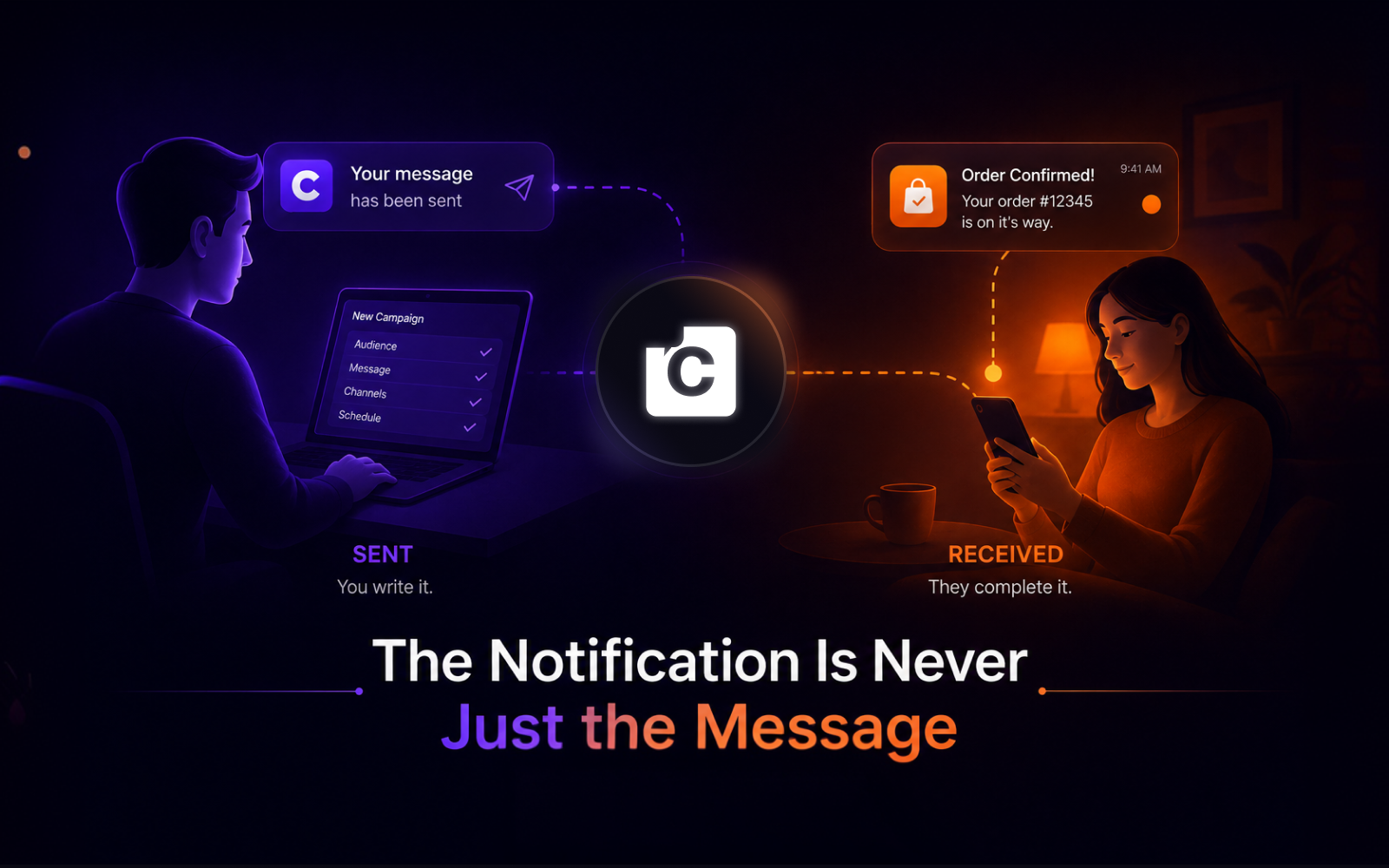
Most teams treat notifications as a broadcasting problem to get the right message to the right person at the right time. But that framing still centers the sender. The best notification writers know something different: a notification isn't complete when it's sent, it's complete when it's received.
The Beholder Problem
There's a painting by Rothko at the Museum of Modern Art that looks completely different depending on where you've just come from. Walk in off the street, and it's an interesting color field. Walk in from the oncology wing of a hospital, and it might stop you in place.
Same painting. Same room. Different reception.
Notifications work the same way, except most teams design them as if they don't. The message gets written, tested, scheduled, and sent. The loop closes on the sender's side. What happens when it arrives - what the user is doing, what they're worried about, what they needed to hear - is treated as someone else's problem. Usually the user's.
This is the gap that most campaign thinking leaves open. Not the copy. Not the channel selection. The assumption that the message is finished when it leaves your hands.
It isn't. The sender writes half. The receiver writes the rest.
The Hierarchy Problem
Here's a reliable way to tell if a notification was written from the sender's perspective or the user's: look at what comes first.
An order confirmation that opens with the brand name is telling you something. Not about the order but about who the message was actually written for. The team needed to confirm the brand was present. The user needed to confirm the order went through. Those are different first sentences.
This isn't a copy problem. It's a perspective problem. Teams write from inside the product, where the brand feels central and every message is an extension of it. Users receive from outside, where only one question matters: does this tell me what I need to know?
The inversion - starting from the user's actual question and working backwards to the message, sounds obvious when you say it out loud. It's consistently not what happens. Re-engagement campaigns are the clearest case. The ‘we miss you’ push is almost always written from a place of company anxiety dressed up as warmth. Users can tell. The ones who left had a reason, and a notification written from the sender's emotional state doesn't address it.
Writing for the beholder means knowing what they're actually holding when the message arrives.
Channel as Tone
An SMS arrives like something happened. A push notification is a tap on the shoulder. An in-app message appears because you're already there, it's contextual by nature, because the context selected itself.
Same sentence. Different channel. Completely different emotional register before the first word is read.
Most teams treat channel selection as a reach decision: which one gets opened, which one costs less, which one the user has enabled. These are real questions. They're just not the only ones. Channel also communicates something about urgency, about relationship, about what kind of message this is supposed to be.
Choosing SMS for a low-stakes promotional message doesn't just waste a send. It gradually trains users that your SMS channel isn't worth treating as urgent which is a problem when you actually need it to feel that way. Channels carry expectations. Using them carelessly spends those expectations down.
The teams that think about channel as a tonal decision - what emotional register does this message need, and which channel naturally carries it - write better campaigns without changing a word of copy. Because the copy is finally arriving in the right frame.
A flash sale in-app message feels like a discovery. The same message as an SMS at 9pm feels like pressure. The words didn't change.
The Moment of Receive
Send time optimization is table stakes - day of week, time of day, cohort-level testing. Most teams have some version of this dialed in.
Receive context is a different question, and most campaigns don't ask it.
Send time is about the clock. Receive context is about the user: what are they actually doing when this arrives? Where are they in their day, their relationship with your product, their decision-making bandwidth? A message that arrives at a statistically optimal send time can still land at exactly the wrong moment for the person reading it.
A delivery update notification at 7am is useful for someone who ordered something they're waiting on. For someone who forgot they ordered anything, it's a non-event. For someone who just got off a night shift, it's an interruption at the wrong end of their day. The timestamp is the same. The receive context is different every time.
This is where most campaigns leave the most room. Not in the copy, not in the channel, but in genuinely thinking through what the user is doing and what they're capable of doing when the message hits. Some calls to action require a decision. Those shouldn't arrive when the user is mid-task, mid-commute, or half-asleep. Some notifications are purely informational. Those can absorb more timing variation. Matching message type to receive context is a different kind of optimization than A/B testing subject lines, and it compounds differently too.
Writing for the Beholder
The art of notifications isn't clever copy or perfect timing. It's designing, consistently, for the experience of reception not the experience of sending.
Hierarchy, channel, and receive context are three different versions of the same question: whose reality is this message written in? The brand's, or the user's?
The teams that get this right aren't necessarily the ones with the most sophisticated tooling or the largest budgets. They're the ones who've shifted perspective — who treat the notification not as a delivery artifact but as something that only becomes meaningful when it lands.
The craft is in designing for reception, not delivery.
CometChat Campaigns gives product and marketing teams the controls to actually execute on this - channel sequencing, timing logic, message hierarchy, built into the same platform where your chat infrastructure already lives. If any of this resonated, it's worth a look.
https://www.cometchat.com/omnichannel-campaigns

Shrinithi Vijayaraghavan
Creative Storytelling , CometChat