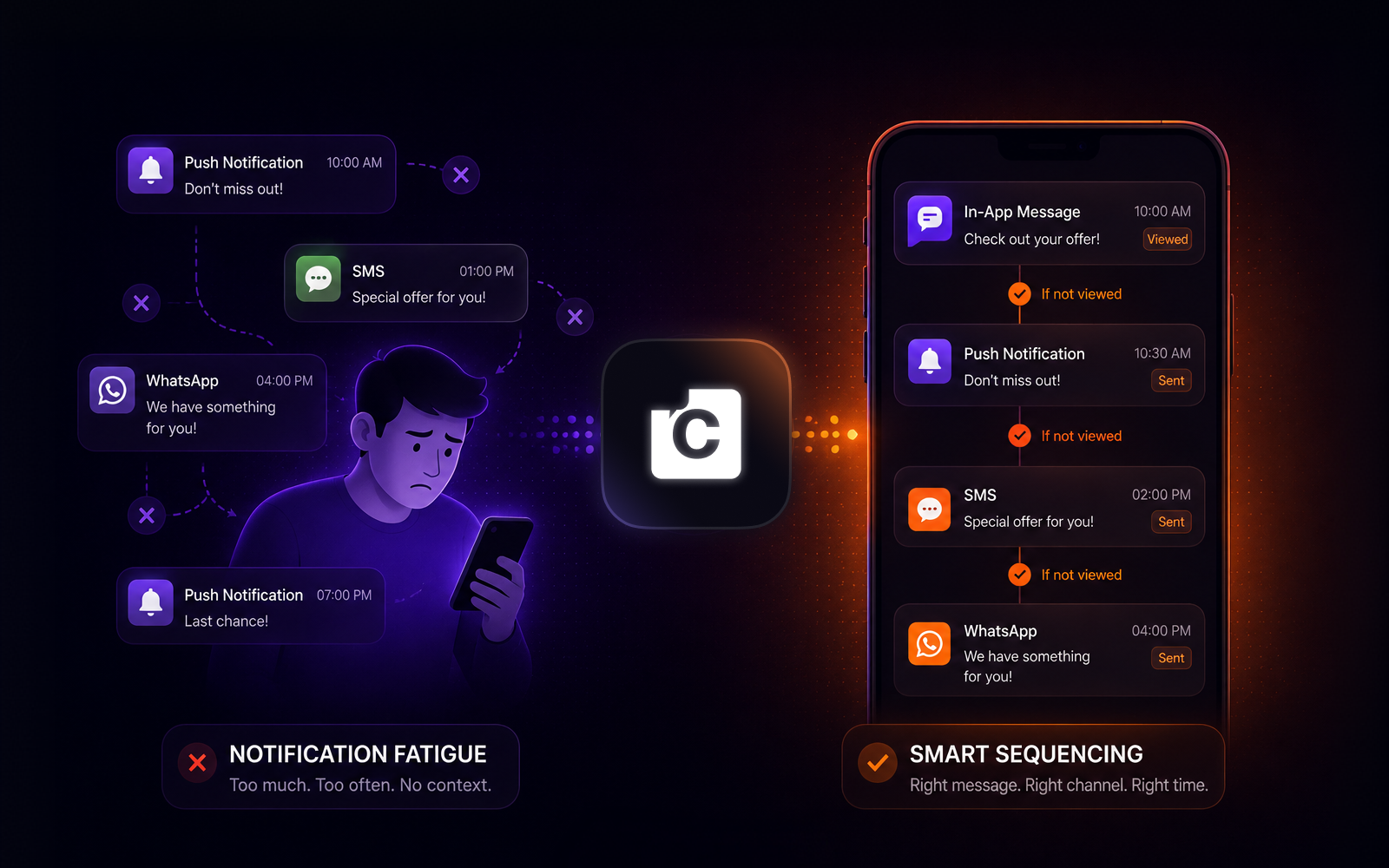
There's a moment every growth team eventually hits: open rates drop, unsubscribes climb, and someone in the room suggests the copy needs work. So the copy gets rewritten. The subject line gets A/B tested. The send time shifts from 10am to 10:14am because someone read a study.
And nothing really changes.
That's because notification fatigue isn't a messaging problem. It's a sequencing problem, a channel problem, and at its root - a product architecture problem. By the time your metrics move, the damage is already done.
The Damage Happens Before You Can See It
Here's what notification fatigue actually looks like operationally: a user gets a push. They don't open it. Three hours later, they get an SMS for the same thing. Then a WhatsApp message. Then another push.
None of this registers as an error in your analytics. Delivery was successful. The campaign ‘ran.’ But somewhere between the second and third message, the user decided your notifications aren't worth reading anymore. They turned them off or just started ignoring them, which is functionally the same thing but harder to measure.
The open rate dip you'll notice next week is a lagging indicator of a decision your product forced them to make days ago. You can't fix that with better copy. You needed to never send those three messages in the first place.
Volume Is the Wrong Variable to Optimize
Most messaging systems are built around volume. More touchpoints, more conversions that's the assumption. And it works, briefly, right until users start treating your notifications the way most people treat car alarms: background noise that implies nothing urgent.
The teams that get this right aren't sending fewer messages because they're conservative. They're sending the right message on the right channel because they've built sequencing logic that accounts for what the user already did.
If a user opened your in-app message, they don't need the SMS. If the push converted, the WhatsApp follow-up is friction, not reinforcement. Sequencing isn't about timing delays between blasts, it's about making each next message contingent on whether the last one worked.
This is a technical decision, not a creative one. And it belongs in your messaging infrastructure, not in a campaign brief.
Channel Intelligence Matters More Than Channel Coverage
There's a version of ‘omnichannel’ that means: we send everything, everywhere, always. It's expensive, it's annoying, and it produces the kind of engagement numbers that look fine until your retention metrics tell a different story.
The more useful version of omnichannel is channel sequencing with fallback logic: start on your highest-signal, lowest-cost channel (in-app notifications, if the user is active), and only escalate to SMS or WhatsApp if the previous touchpoint went unanswered. You reserve the expensive, interruptive channels for the moments that actually need them not as a default.
This does two things. It keeps your cost-per-message reasonable at scale. And it keeps users from associating your brand with interruption.
The second effect is harder to model but more consequential. A user who trusts that your SMS means something important will open it. A user who's been trained by three months of redundant blasts will see your sender name and feel mild irritation. That's not a recoverable state.
Why This Is a Product Problem
Marketing teams are usually the ones blamed for notification fatigue. But marketing teams are operating within the constraints of whatever messaging infrastructure the product team built. If the infrastructure doesn't support behavior-triggered sequencing - if it can't check whether a message was viewed before firing the next one, then even a thoughtful messaging strategy gets flattened into: send everything, measure what we can, iterate.
The fix isn't a better campaign strategy. It's messaging infrastructure that treats user behavior as a first-class input: one that can sequence across channels, check delivery and view status before escalating, and apply rules that match the actual logic of your engagement goals.
When that infrastructure exists, ‘notification fatigue’ stops being a recurring agenda item. It stops being something you manage after the fact. Your system just doesn't do the thing that causes it.
What CometChat Campaigns Gets Right
CometChat Campaigns is built around this exact problem. You define your audience, your channels, and your sequence logic and the platform handles escalation based on what actually happened: was it delivered, was it viewed, was it clicked?
You start in-app. If the user doesn't engage, you fall back to push. If still nothing, you can escalate to SMS or WhatsApp. Each step is conditional, not automatic. The user who already converted never sees the follow-up. The user who missed it does.
It's a small architectural shift from broadcast to conditional delivery and it's the difference between a notification system that earns attention and one that trains users to ignore it.
Notification fatigue isn't inevitable. It's what happens when volume substitutes for intelligence. The teams who solve it aren't better marketers. They're building on infrastructure that treats the next message as a function of what the last one accomplished and that's a product decision worth making early.

Shrinithi Vijayaraghavan
Creative Storytelling , CometChat