Building a chat interface in Flutter looks straightforward at first.
A message list.
An input field.
Maybe a couple of message bubbles.
Then you start implementing it.
Suddenly you're dealing with typing indicators, read receipts, media attachments, presence updates, and real-time synchronization. On top of that, you’re managing widget trees, handling state updates efficiently, and making sure long message lists don’t cause unnecessary rebuilds or scroll lag.
Most tutorials solve this by giving you hundreds of lines of Dart to stitch together.
It works, but it’s time-consuming and hard to adapt for production.
Even with a flutter chat UI kit, you still need to assemble components, configure features, and wire everything together before the interface feels complete.
The CometChat UI Kit Builder for Flutter takes a different approach.
Instead of building your chat UI from widgets upward, you configure the entire experience visuallu, then export native Flutter code that matches your setup.
By the end of this guide, you’ll have a fully configured flutter chat UI running inside your app, without starting from a blank widget tree.
What is the CometChat UI Kit Builder for Flutter?
The CometChat UI Kit Builder for Flutter is a visual, low-code tool that lets you configure a complete chat interface before writing UI code.
It works on top of the CometChat Flutter UI Kit, which provides production-ready components for real-time messaging.
Instead of assembling widgets manually, you:
Configure features
Customize layout and styling
Preview the UI
Export ready-to-use Flutter code
Under the hood, you’re working with real components, not mockups. The exported output is native Flutter/Dart code that reflects your exact configuration.
With the Builder, you can:
Configure chat layouts
Toggle messaging and engagement features
Enable calling capabilities
Customize themes and typography
Export a ready-to-integrate Flutter module
Why Use the Flutter UI Kit Builder?
Most Flutter teams build chat interfaces using a familiar workflow:
Install a UI kit
Import chat components
Wire them together
Configure features
Apply styling and themes
It works, but you don’t see a complete interface until fairly late in the process.
The Builder changes that.
Instead of assembling UI components first, you configure the chat experience visually and export a working module.
That shift brings a few practical advantages:
Faster setup: Skip the manual assembly of multiple widgets just to get a working UI.
Cross-platform consistency: One configuration powers both iOS and Android builds.
Visual UI preview: See layouts, features, and styling before integrating into your app.
Simplified customization: Adjust themes, typography, and feature toggles in one place.
In practice, Flutter teams can go from UI concept to a working chat interface in a few hours.
Prerequisites
Before you begin, make sure your environment includes:
Flutter SDK (stable channel) with Dart 3+
Android Studio, VS Code, or IntelliJ
Android 5.0+ (API 21+) device or emulator
iOS 13+ simulator or device (with Xcode and CocoaPods)
A CometChat app with App ID, Auth Key, and Region
Step 1: Configure Your Chat UI in the Builder
Start by opening the CometChat UI Kit Builder from your dashboard.
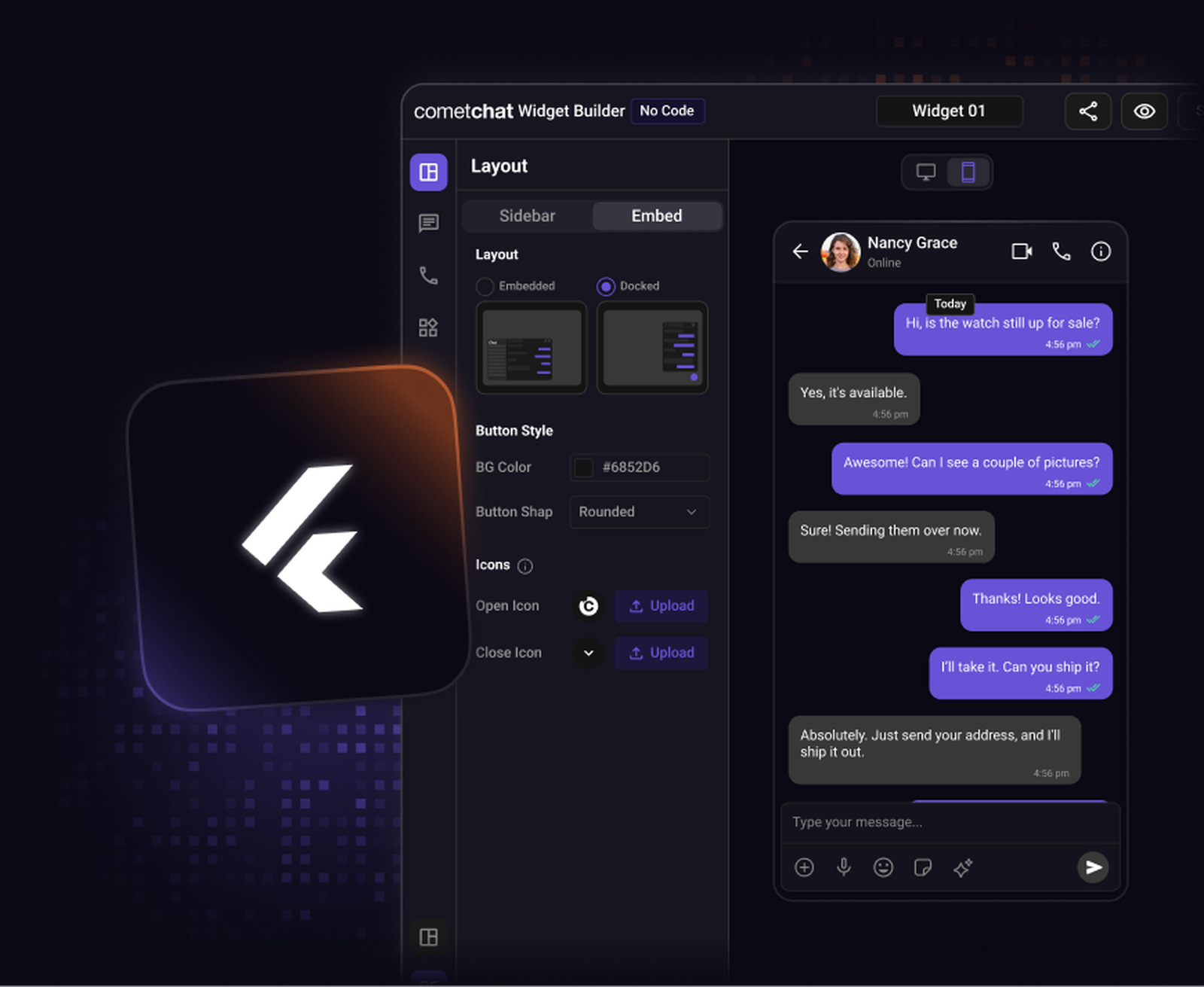
The Builder provides a visual interface where you can configure your chat experience without editing UI code.
You’ll see:
A settings panel (features, layout, themes)
A live preview pane showing your chat UI
From here, you can adjust:
Layout structure
Messaging features
Engagement capabilities
Visual styling
This allows you to experiment with different configurations before integrating anything into your Flutter project.
Step 2: Configure Chat and Engagement Features
Inside the Builder, you can control the features that power your chat experience.
Core messaging features include:
1:1 messaging
Group conversations
Message reactions
Typing indicators
Read and delivery receipts
Media sharing
Mentions and tagging
These are backed by CometChat’s real-time infrastructure, so message delivery and syncing are handled out of the box.
Additional engagement features:
Polls and surveys
Message translation
Voice and video calling
Notifications
Instead of wiring these into your widget tree manually, you enable or disable them directly through the Builder UI.
Step 3: Customize Theme and Styling
Your chat UI should feel like part of your app—not something bolted on.
The Builder allows you to customize:
Colors: Define brand colors for message bubbles, headers, and UI elements.
Typography: Set fonts and text styles used across the interface.
Layout styling: Adjust spacing, backgrounds, and component appearance.
All changes are reflected instantly in the preview, making it easy to iterate before exporting.
Step 4: Export the Builder Module
Once your configuration is complete, you can export the Flutter module. The exported package typically includes:
Pre-configured Flutter widgets
Configuration JSON
UI assets
Theme setup
Because the UI Kit understands this configuration, your chat interface behaves exactly as defined in the Builder.
Step 5: Integrate the Builder Module into Your Flutter App
After exporting, integrate the module into your Flutter project.
Copy the Builder module
Add the exported files into your project structure.
Install dependencies
Ensure the CometChat Flutter packages are installed.
Initialize the CometChat SDK
Initialize the SDK using your app credentials.
Load the Builder configuration
Use the exported configuration file to initialize your chat UI. Once loaded, the interface automatically reflects your Builder settings—features, layout, and styling included.
A Faster Way to Build Chat in Flutter
Building a chat interface in Flutter usually involves managing widget trees, state updates, and real-time behavior across multiple components.
The CometChat UI Kit Builder simplifies that entire workflow. Instead of assembling everything manually, you:
Configure the chat interface visually
Enable messaging features
Customize themes and layouts
Export ready-to-use Flutter code
For teams under pressure to ship quickly, this is a much faster path.
You still retain full control over the UI and SDK for deeper customization, but you start with a production-ready chat interface from day one.
Try the CometChat UI Kit Builder.

Shrinithi Vijayaraghavan
Creative Storytelling , CometChat