Chat SDKs
Android Chat SDK: The fastest way to add chat to your mobile app
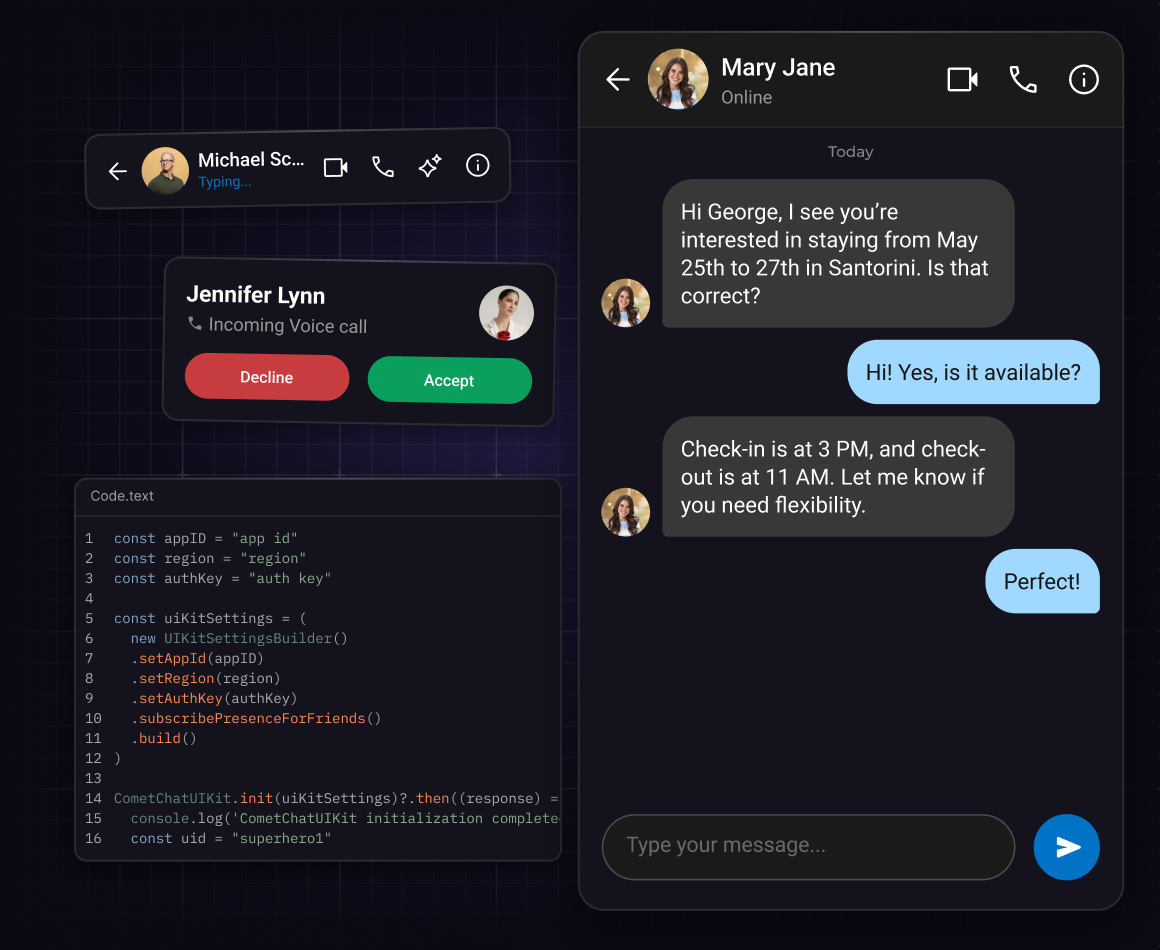


Scalable Infrastructure
Seamless real-time chat experience
Enterprise-grade infrastructure that ensures low latency and reliable messaging.
-
Zero-config WebSocket handling: Automatic socket connection management with smart reconnection.
-
Lightning-fast message delivery: Sub-100ms real-time delivery with guaranteed ordering.
-
Message history & persistence: Automatic message syncing, caching, and pagination.
-
Global edge network: 35+ locations worldwide for low-latency communication.

Pre-Built UI Library
Pre-built android chat components
Speed up development with customizable components designed for real-world use cases.
-
Conversation list : Display active conversations with unread indicators, last message preview, and timestamps.
-
User list: Show contacts, group members, manage user roles, and indicate online/offline status.
-
Threads, reactions & mentions: Enable structured discussions with threaded replies, reactions, and @mentions.
-
Search: Allow users to find messages and conversations instantly with filters and highlighting.

Powerful Backend
Smart state management
Built-in state handling for all the complex parts of chat.
-
Presence management: Real-time user status updates across channels
-
Real-time indicators: Instant typing indicators and presence state
-
Read receipt handling: Real-time message seen status and customizable receipts
-
Message counters: Accurate unread counts across channels and threads

Rich User Engagement
Feature-rich messaging experience
Engage users with interactive features that enhance conversations.
-
File & media sharing: Drag-and-drop uploads with real-time progress tracking.
-
GIFs: Built-in Giphy integration with customizable content filters
-
Thumbnail and image previews: Smart image loading with blur previews
-
Videos and voice notes: Record and share with automatic transcoding
-
Real-time message translation: Instant translation across 100+ languages

Android chat deployment, simplified
Three steps to launch in-app chat with full control
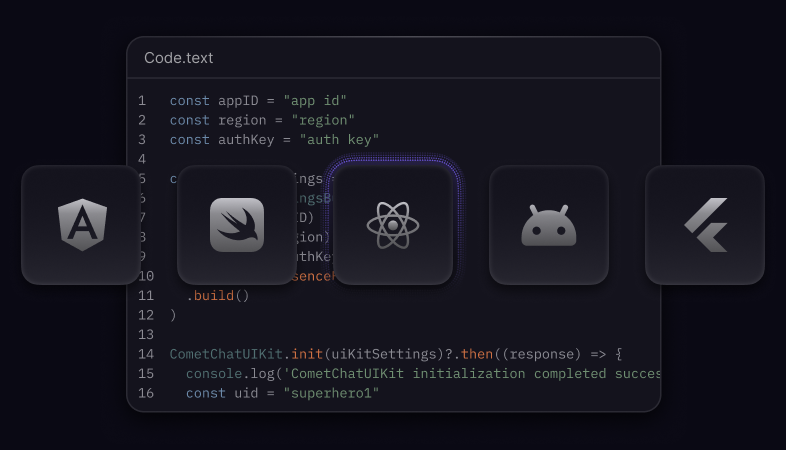
Add the Android Chat SDK
Start by integrating the Android SDK into your app. This gives you real-time messaging, presence, and event handling out of the box.

Design every screen and flow
Build your chat UI exactly the way your product needs it. Create custom screens, interactions, and workflows, with the flexibility to extend and evolve your experience as requirements grow.

Launch your in-app chat
Once your UI is ready, sync your user base with CometChat and deploy with confidence.
Integrate android chat in minutes
Reduce development time with ready-to-use android chat components



Enterprise-Grade Security
Security and scale you can trust
Global edge network, iron-clad security, and 99.999% uptime. Battle-tested infrastructure that scales to billions of users.

Edge network
Lightning-fast chat delivery through 35+ edge locations worldwide, ensuring minimal latency for all users.

Uptime SLA
99.999%

Scalability
5B+ chats
Enterprise security


Beyond Basic Messaging
Essential Tools for chat adoption, platform safety, and user engagement
Enterprise-grade content moderation to keep your chat safe and compliant.
Advanced AI filters block harmful content with 99.99% accuracy and enable immediate threat response.

Cross-platform notification system with intelligent delivery.
Send email, SMS, and push notifications from a central dashboard with delivery tracking and customizable routing preferences.

Get deep insights into user behavior and chat performance.
Real-time analytics on messaging performance and user engagement with flexible export capabilities.


Widget Builder
A no-code chat builder for any platform, built for high-impact use cases that need real chat fast and flexible.

UI Kit Builder
A low-code chat builder that is fully customizable, easy to integrate, and scales with your product.
UI Kits
Comprehensive UI Kits with all the chat features you need, designed to plug in natively and grow with your app.
FAQs
Got questions? We’ve got answers.
Here’s everything you need to know to build chat in Android using our SDK or chat APIs?
An Android Chat SDK is a software development kit that enables developers to add real-time messaging to native Android applications. It includes messaging infrastructure, WebSocket handling, push notifications, presence tracking, and read receipts out of the box. The CometChat Android Chat SDK provides APIs and UI components that simplify chat integration without building backend systems from scratch. This allows teams to launch scalable in-app messaging experiences faster.
To integrate CometChat's Android SDK, you need to add the dependency to your project, initialize it with your app credentials, and authenticate users within your Android application.
The SDK automatically manages real-time message delivery, connection handling, and synchronization across devices. Developers can build fully custom chat interfaces or use CometChat’s pre-built Android UI components to accelerate development. Integration is straightforward and designed for production-ready deployment.
Yes, CometChat provides Chat APIs alongside the Android Chat SDK. These APIs allow developers to create users, send server-side messages, moderate content, and integrate chat with backend systems.
While the Android SDK simplifies real-time communication and mobile integration, the Chat API offers lower-level control for advanced workflows. The SDK leverages these APIs internally to ensure reliable and scalable messaging.
An Android Chat SDK provides a higher-level toolkit that handles real-time messaging, connection management, push notifications, and state synchronization automatically. In contrast, an Android Chat API consists of REST endpoints that require developers to manually implement networking, UI rendering, and message handling.
The SDK accelerates mobile development and reduces complexity, while the API is better suited for backend-driven architectures. Most Android teams prefer the SDK for speed and scalability.
Yes, you can build an Android chat application using only Chat APIs, but this requires manually managing WebSocket connections, offline storage, push notifications, and synchronization logic. While APIs offer maximum flexibility, they significantly increase development time and maintenance overhead. An Android Chat SDK abstracts these complexities and ensures reliable performance across devices. For most applications, the SDK is the more efficient solution.
The Android Chat SDK uses both WebSockets and REST APIs to deliver seamless real-time messaging. WebSockets power instant message delivery, typing indicators, and presence updates, while REST APIs handle configuration, history retrieval, and backend operations. This hybrid architecture ensures low latency, automatic reconnection, and reliable message synchronization. Developers do not need to manage networking complexity manually when using the SDK.
Let's map out how CometChat works for you.
30 minutes. Real answers. A plan you can actually act on.
Pick a time that works, talk to someone who knows the product.
Your use case shapes the call - no guessing, no repeating yourself.
No commitment. Just a straight conversation about how this fits - and if it doesn't, we'll say so.
Trusted by teams building conversations at scale.