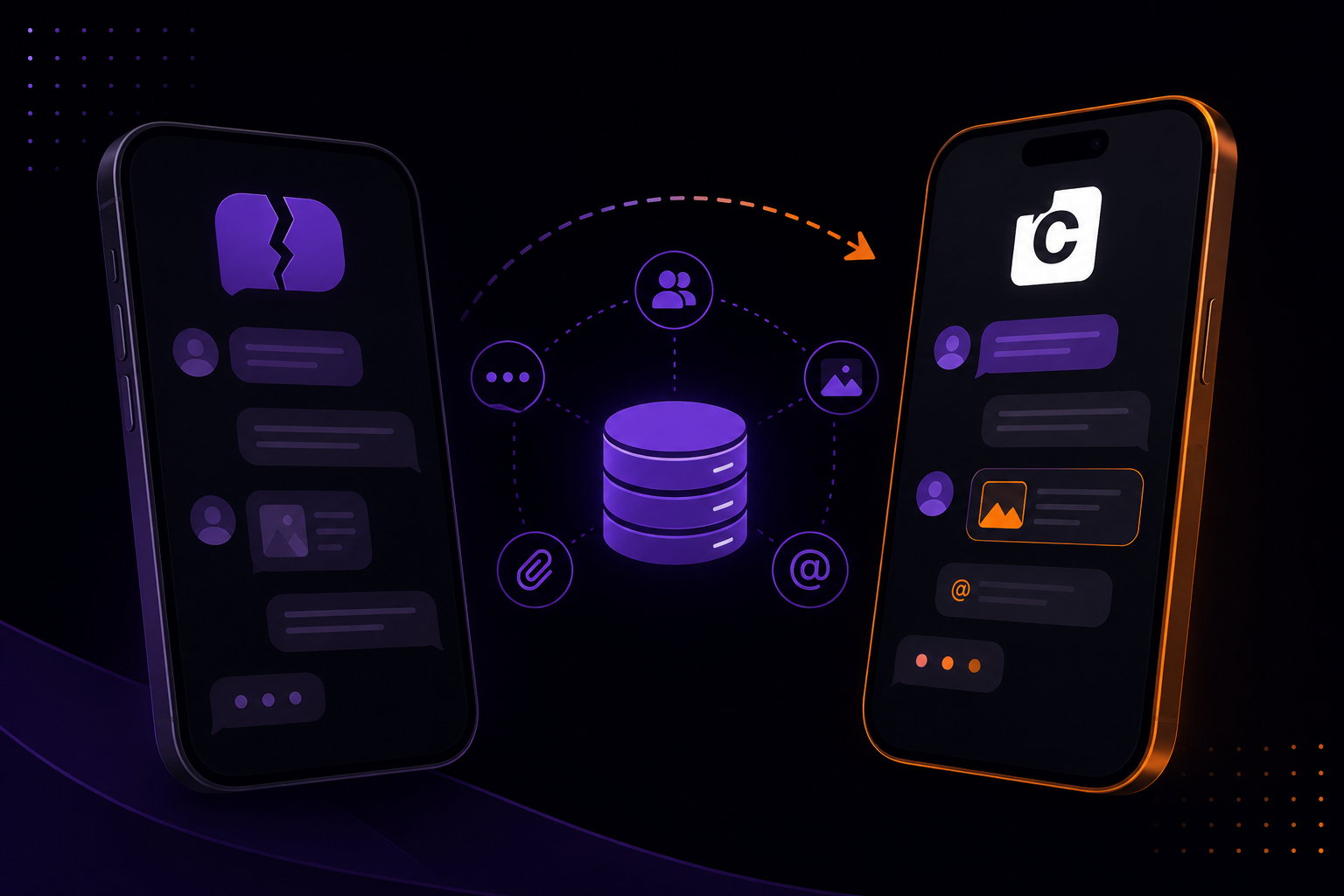
Every few years, a chat provider a lot of teams built on announces the end of life: a firm date, and a migration guide nobody asked for. If that notice landed in your inbox and it's the system routing your support or in-app conversations, you're not choosing a new chat vendor right now - you're running a migration, on a clock that already started.
That's a different problem than ‘which chat SDK should we pick.’ Picking is the easy part. What actually determines whether the next six weeks go smoothly is whether you treat migration as infrastructure work - data, ordering and downtime instead of a procurement decision that happens to come with an SDK attached.
The Decision That Comes Before Any of the Technical Ones
Before touching a single API call, there's one question that shapes everything downstream: can this happen in a maintenance window, or does it have to happen live, with users straddling both systems while you cut over?
If you can take the downtime - a genuine platform switch, done once, with a clear before and after a historical import is the right shape. Move everything that's currently at rest: users, messages, groups, conversations, all in one pass, all available from day one on the new system.
If you can't take the downtime - a mobile app where users update on their own schedule, a support desk that can't go dark - you need something that keeps both systems talking during the transition, so a message sent by someone still on the old client and a message sent by someone already upgraded both land somewhere real. That's a fundamentally different, harder problem than bulk import, and it's worth being honest with your team about which one you're actually solving before you start writing migration scripts.
History Is More Than the Text of the Message
The part that gets underestimated is how much ‘message history’ actually contains. A message import that only moves the text string is a message import that quietly breaks every conversation view that expects delivery and read state, every attachment link, every thread reference, every @mention.
Done properly, each imported message carries its own unique identifier, its sender and receiver, and its full timestamp trail - when it was sent, delivered, and read - not just a single "created at" field. Attachments come across as structured objects with their own URL, filename, and MIME type, not as a text blob describing them. Mentions carry the actual user details of who was mentioned, so a mention formatter on the new system has something to render instead of a raw string it doesn't recognize.
Skip any of that and the migration technically ‘works’ - messages exist - while the product quietly regresses. Read receipts that no longer mean anything. Threads that don't thread. That's the gap between moving data and moving a conversation.
Sequence Is Worth Getting Right, Even When It's Not Required
One detail worth building your migration plan around: a message record needs a sender, a receiver, and if it's a group message a group to attach to. The message import API can carry that detail inline, embedded in the message payload itself, which technically means you don't have to import users and groups first.
In practice, though, importing users and groups first is the simpler path. It means every message you import afterward can reference a sender and receiver that already exist, instead of every single message payload needing to carry full user and group details just in case. Skip that ordering and you can still get there - you'll just be repeating the same user and group data across thousands of message records instead of once, which is where migrations get slow and error-prone rather than where they technically break.
Migration Paths, Already Built
None of this requires reinventing the wheel - it requires picking the right tool for the shape of migration you actually have.
For a clean cutover, CometChat's Data Import REST APIs handle handle bulk ingestion of users, groups, group members, and messages, preserving sender and receiver detail, delivery and read timestamps, attachments, and mentions rather than flattening everything down to plain text. For a migration that can't take downtime, live data migration bridges the old and new systems so users transition gradually without losing messages in between - that path goes through a conversation with CometChat's sales team rather than a generic API call, because zero-downtime migration is genuinely a different engineering problem than a bulk import.
A sunset deadline is a forcing function, not a design brief. The platforms that come out the other side in good shape are the ones that treated this as the data-and-sequencing problem it actually is.If a clock is already running on yours, check out CometChat - the import tooling and the live-migration path are both already built.

Shrinithi Vijayaraghavan
Creative Storytelling , CometChat