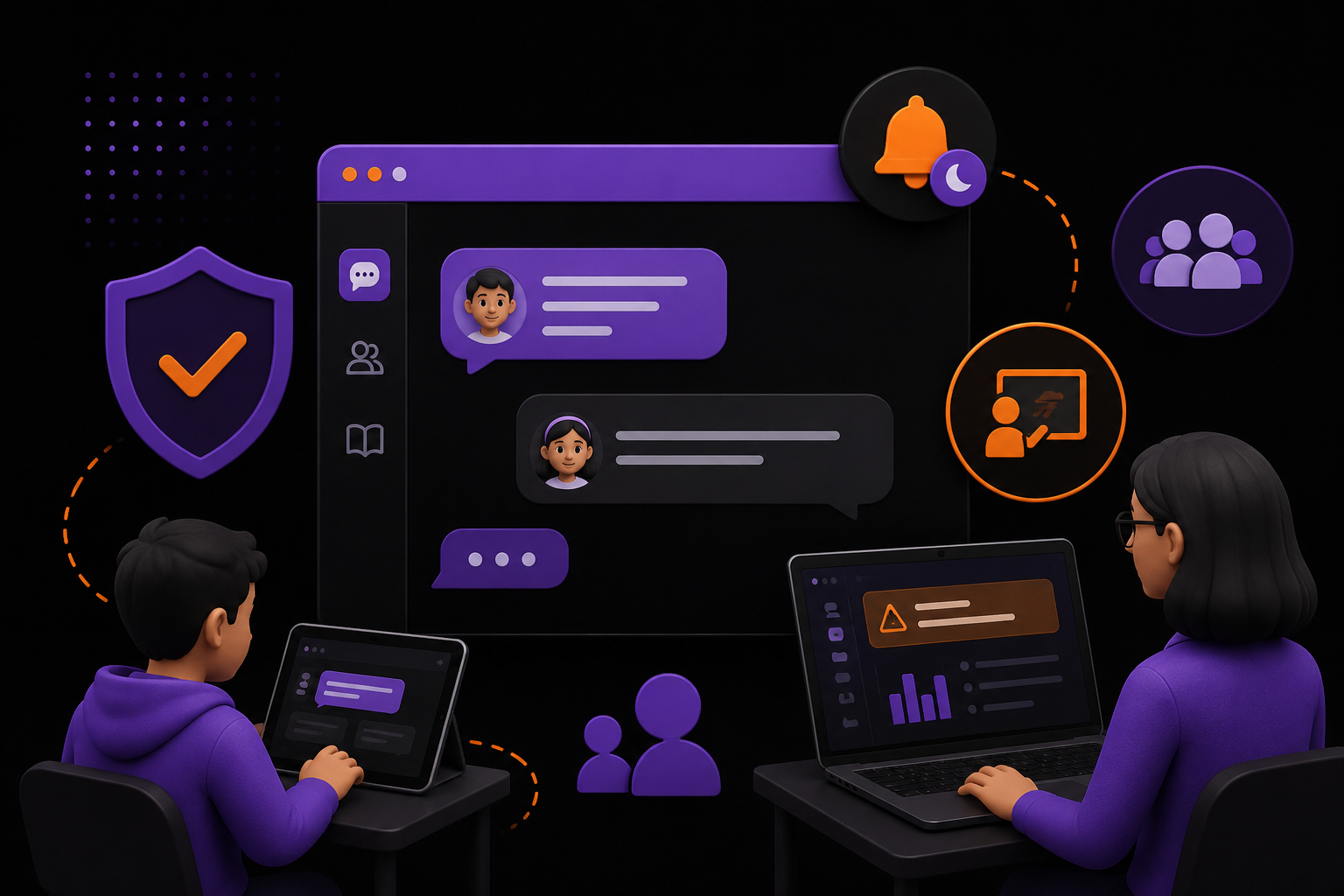
Someone on the product team asks for ‘a chat feature so students can ask questions during class.’ Reasonable request. Ships in a sprint. Then a parent calls the school about a message their eleven-year-old received, and everyone learns at once that ‘chat feature’ was never the actual scope.
That's edtech chat in one sentence: it presents as a UX problem - bubbles, typing indicators, who's online and it's actually a compliance and safety problem that happens to render as a UX problem. Every other vertical gets to treat those as separate concerns. Education doesn't get that luxury, because a meaningful share of the users in the room are legally minors, and the room itself is being watched by parents, administrators, and eventually a regulator.
The Users Aren't Adults, and the Product Can't Pretend Otherwise
Most chat products are built with an implicit adult user in mind - someone who can report harassment, block a stranger, and understand what ‘public’ means. Classroom chat can't make that assumption. COPPA exists specifically because platforms with users under 13 have different obligations, and ‘we'll bolt on compliance before launch’ is the sentence that turns into a very long call with legal.
This isn't a settings toggle. It changes what data you can collect, what a default should be, and what "safe by default" actually means for a nine-year-old versus a college freshman in the same product.
Every Message Needs a Second Reader Who Isn't a Person
A classroom is dozens of simultaneous conversations, and no teacher is reading all of them in real time nor should they have to, or every class becomes a surveillance exercise instead of a lesson. What you actually need is moderation that reads for real harm and lets everything else pass, so a teacher's attention goes to the one flagged exchange instead of scrolling four group chats hoping to catch something.
That means detection built for what actually goes wrong with minors online not just profanity, but the coded stuff, the slow escalation, the contact-sharing that looks innocent in isolation. CSAM detection and COPPA compliance aren't add-ons here; they're the baseline a platform with underage users has to clear before anything else about the product matters.
Visibility for the Teacher, Not Surveillance of the Student
There's a real tension in classroom chat that most vendors wave away: a teacher needs enough visibility to catch a genuine problem, without every private exchange between two students feeling monitored. Get that balance wrong in either direction and you lose something either safety, or the honest peer conversation that makes a class feel like a class instead of a broadcast.
The answer isn't ‘log everything and hope no one reads it.’ It's rules that differ by role and by channel - a class-wide announcement channel behaves differently than a small-group project chat, and a teacher account should see different signals than a student one. Configuring that by hand for every class, every semester, doesn't scale. Configuring it once as a rule set does.
Quiet Channels Are a Feature, Not an Afterthought
Not every classroom conversation should ping every phone in real time. A group project thread at 11pm the night before it's due is exactly the kind of thing that shouldn't be interrupting a fifteen-year-old's evening or a teacher's, for that matter. Edtech chat needs the ability to be quiet on purpose: channels that hold messages without demanding immediate attention, distinct from the ones that genuinely need it, like a safety alert or a live-class prompt..
Built With Minors in the Room, Not Retrofitted for Them
None of this is a reason to avoid building chat into an edtech product - it's a reason to build it on something that already assumes minors are in the room.
CometChat's compliance is pre-certified for exactly this: COPPA, CSAM detection, GDPR, and the rest, built in rather than retrofitted after a district asks. The moderation layer is contextual rather than keyword-matching, with a no-code dashboard to configure rules by role, channel, or message type which is precisely the mechanism that makes "teacher sees more, students see less noise" a configuration instead of a custom build, and that same role-and-channel logic is what lets a project thread and a safety alert behave differently instead of both demanding the same urgency. Multi-channel notifications - push, SMS, email, with quiet hours and mute controls honored automatically - give a platform the levers to decide what actually interrupts someone's evening and what waits until morning. Human-in-the-loop review means the one flagged message actually reaches a person, and engagement and conversation data gives administrators a way to see what's happening without reading every message to get it. Multi-tenancy lets a platform stand up isolated, configurable instances per district or customer without re-architecting for every new one it's the same model this documentation names directly for education, with each school running as its own separate app.
Platforms already running education chat on this foundation see it in outcomes that matter to a school, not just to engineering: real increases in student engagement and course completion, because the chat layer earns trust instead of costing it.
The classroom was always going to need moderation. The only question is whether you design for that from day one, or discover it the day a parent calls. If you'd rather design for it, talk to CometChat the compliance and moderation groundwork this piece walks through is already built.

Shrinithi Vijayaraghavan
Creative Storytelling , CometChat