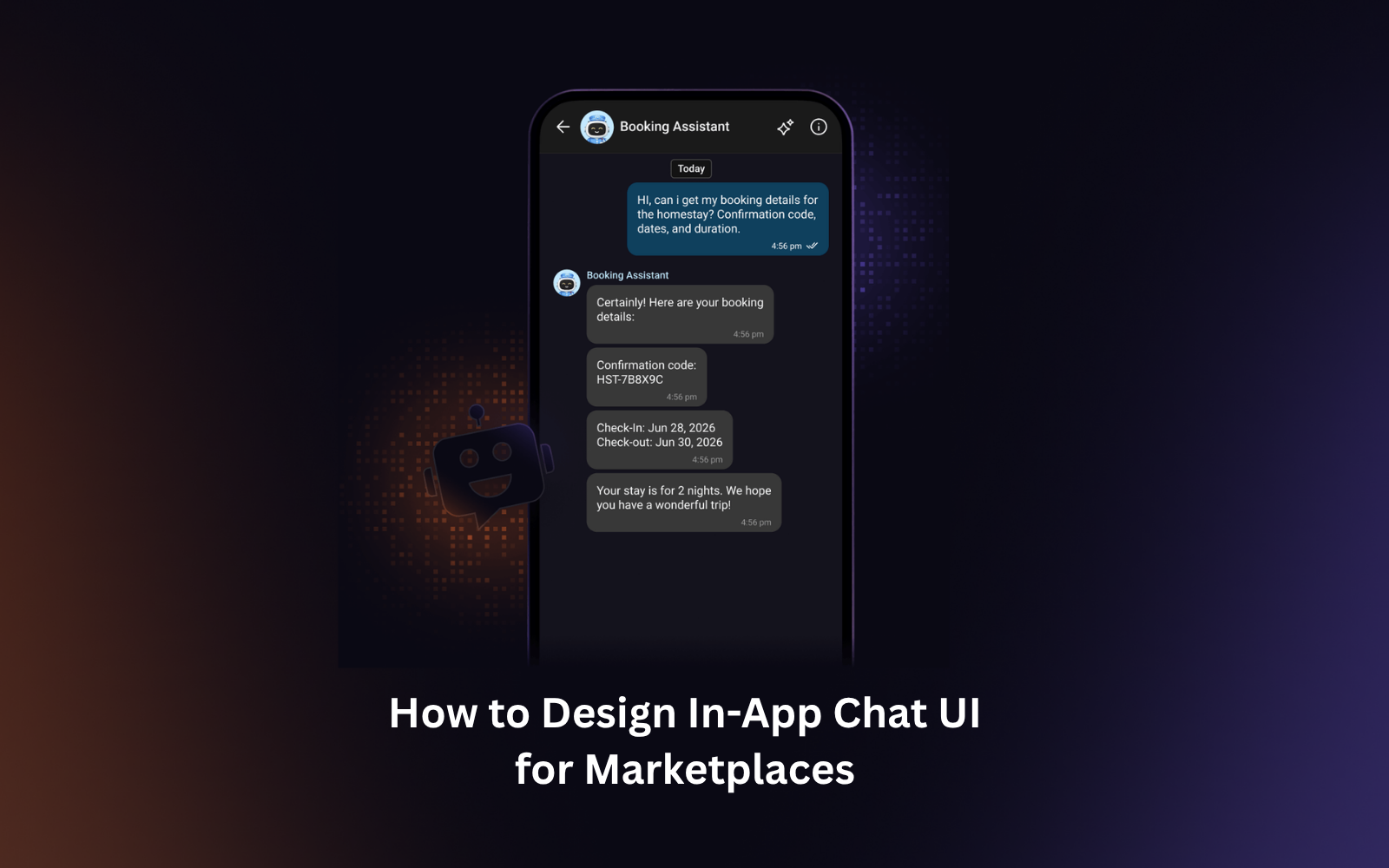
Good in-app chat UI design for a marketplace does three things generic chat can't: it makes strangers trust each other enough to transact, it keeps the offer and the price inside the thread instead of buried in plain text, and it enforces safety without stalling the conversation. Consumer messaging patterns assume the two people already know each other. In a marketplace, they don't, and money is on the line — so the design rules change. CometChat is a chat and messaging platform for developers, and its components support the marketplace-specific patterns below, which is why the examples here reference them directly.
These are principles, not trends. The AI and message-type specifics will keep moving; the reasons behind them won't.
Where generic chat UI patterns break when money is involved
Standard messaging patterns quietly work against you the moment a transaction is at stake. Read receipts, presence dots, and plain-text threads are neutral between friends and loaded between a buyer and a seller who've never met.
Read receipts turn into pressure. A ‘seen’ with no reply reads as a snub during a negotiation, not a shrug.
Presence dots imply availability the seller may not want to promise. ‘Online’ becomes ‘why are you ignoring me.’
Plain-text offers get lost. ‘$40?’ three screens up is not a record of anything.
Frictionless sending is great until it's a scam link. Zero moderation is a design decision, and the wrong one.
The fix isn't to strip features out. It's to design each one for two strangers doing business. CometChat exposes these as configurable behaviors like receipts, presence subscription modes, moderation. So you tune them per surface instead of accepting the consumer-app defaults.
Design the header to carry trust, not just a name
The chat header is your primary trust signal, so it should show identity, not just a display name. Between strangers, the question under every message is ‘who am I actually talking to.’ Put the answer where they're already looking.
Surface a verified badge, rating, response rate, and join date in the header or a tap-away profile. In CometChat, user metadata rides along with the profile, so the UI Kit's conversation and message headers can render these signals without a separate lookup. The design goal: a buyer should never have to leave the thread to decide whether the seller is real.
Put the offer inside the thread, not in the text
Offers and prices belong in structured message types, not free text. A negotiation that lives in ‘$40’ / ‘35?’ / ‘deal’ is unsearchable, unenforceable, and easy to dispute later.
Use a custom or interactive message - an offer card with the item, the price, and accept/counter actions so the deal is a first-class object in the conversation. CometChat supports custom messages with structured data (order details, event invitations, and the like), which is exactly the primitive an offer card needs. The pattern that ages well: anything transactional gets its own message type, rendered as a card, with the state visible at a glance.
Enforce safety without killing the conversation
Safety should run in the background and only interrupt when it has to. Heavy friction captchas, approval gates, aggressive filters on every message kills the momentum a marketplace runs on. But zero enforcement invites scams, and the first fraud story spreads faster than any feature.
Design for quiet enforcement: keep report and block one tap away but out of the main flow, and let moderation happen on the server. CometChat's AI Moderation reads full conversation context to flag spam, hate speech, and abuse with fewer false positives than keyword matching, so legitimate haggling doesn't get caught in the net. Safety the user only notices when something's actually wrong is the target.
Keep the transaction legible
The thread should always answer ‘what are we even talking about.’ Marketplace chats reference a specific listing, and losing that context is where confusion and disputes start.
Pin the item - image, title, price to the top of the conversation, and render order or delivery status as inline system messages rather than another gray text bubble. CometChat's message list handles custom and system message types, so status updates read as distinct events, not chatter.
What's changing in 2026: AI in the thread
AI is moving from a novelty to a default layer in marketplace chat UI design. Used well, it lowers the effort of starting and closing a conversation without making the interface feel automated.
Conversation starters give a hesitant buyer a first line, which lifts reply rates on cold listings. CometChat surfaces these in the message list when enabled.
Smart replies speed up sellers fielding the same three questions all day; CometChat adds them to the composer's action sheet.
Conversation summaries let either side catch up on a long negotiation without re-reading forty messages.
Richer interactive messages: offer cards, scheduling, payment prompts keep more of the deal inside the thread.
The principle under all of it: AI should reduce friction in the human conversation, not replace it. A marketplace where the buyer suspects they're talking to a bot is a marketplace with a trust problem.
FAQ
What makes marketplace chat UI different from regular messaging UI? The two people are strangers and money is involved. That changes how you treat read receipts, presence, offers, and moderation. Patterns that are neutral between friends become loaded between a buyer and seller.
How should you handle offers and prices in a marketplace chat? Put them in structured message types, not plain text. An offer card with item, price, and accept/counter actions keeps the deal searchable and enforceable. CometChat's custom messages support this with structured data.
How do you keep marketplace chat safe without adding friction? Run moderation on the server and keep report/block one tap away but out of the main flow. CometChat's AI Moderation uses full conversation context, so real negotiation isn't flagged as abuse.
Should marketplace chat show presence and read receipts? Only where they help. Between strangers, a ‘seen’ with no reply or an ‘online’ status can create pressure or imply availability. Make them configurable per surface rather than on by default.
Does CometChat support the message types marketplaces need? Yes. CometChat supports custom and interactive messages with structured data — order details, offers, event invitations — plus AI features (starters, smart replies, summaries) and context-aware moderation, across React, React Native, Flutter, Angular, iOS, and Android.
Marketplace chat looks like consumer chat right up until the first disputed price and the first scam link. Design it for two strangers doing business, and it holds when the transaction gets real.

Shrinithi Vijayaraghavan
Creative Storytelling , CometChat