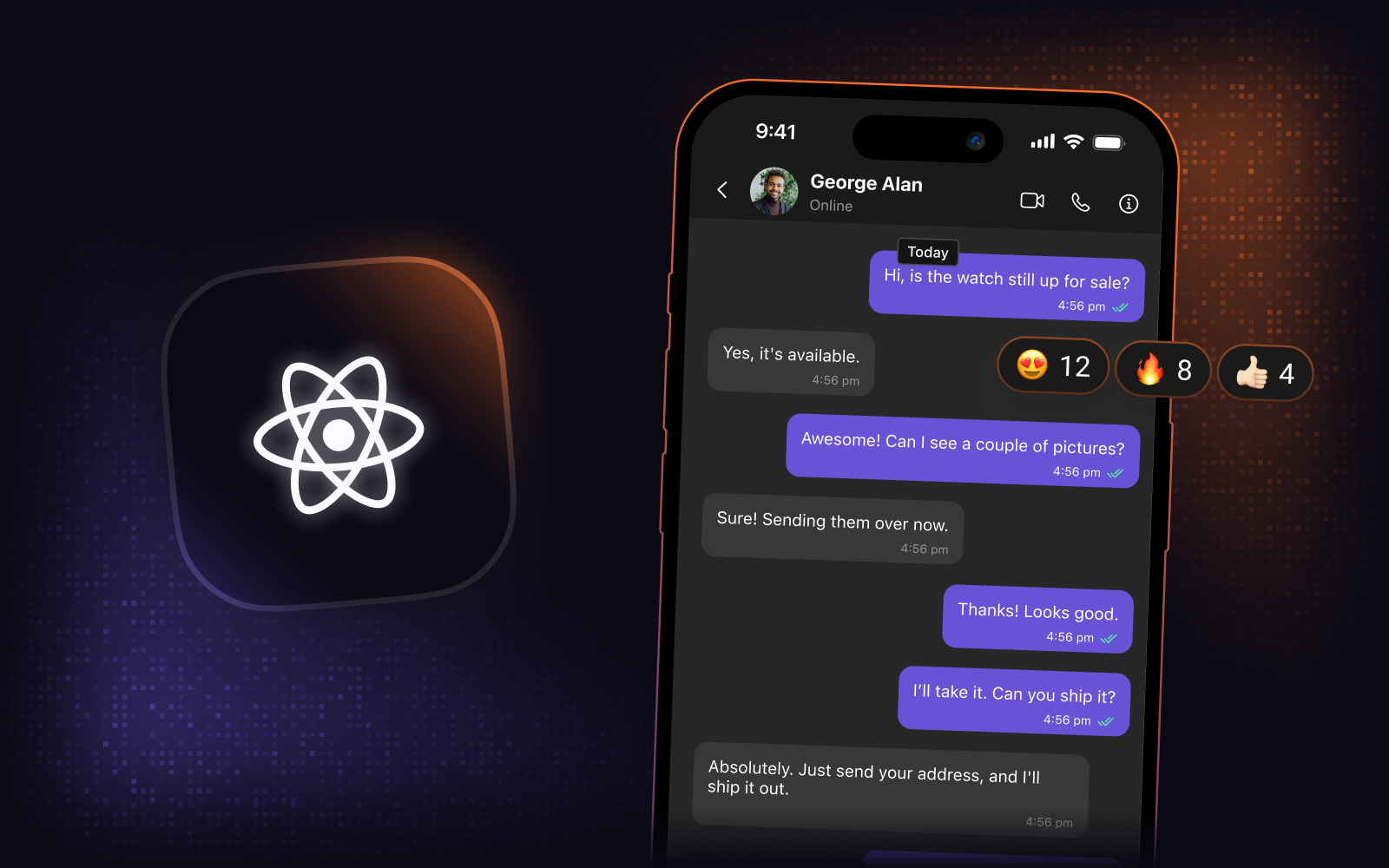
At some point, the thumbs-up stopped being a shortcut. It became the whole sentence. And for a lot of messages, that's completely fine - maybe even better.
We don't talk about it much, but communication has been quietly compressing for years. The average reply is shorter. The average response time is faster. And for a growing category of messages from acknowledgements, agreements, light reactions to something funny or thoughtful - people aren't typing at all. They're reacting.
Message reactions aren't a fun add-on. They're how a significant portion of people actually communicate in async environments today. If your application has messaging and doesn't support them, you're not just missing a feature. You're missing a communication pattern.
The compression is real
Somewhere between email and Slack, the expected cadence of conversation shifted. Email taught us to write paragraphs. Chat taught us to write sentences. And now, reactions are teaching us to say something with a single emoji and feel completely understood doing it.
A 👍 often replaces ‘Got it,’ ‘Sounds good,’ or ‘Makes sense.’ A ❤ does the work of ‘Love this’ instantly. A 😂 closes a thread without needing a reply at all.
This isn't users being lazy. It's users being efficient. When the feeling is simple, the response should be too. A full typed reply to ‘Shipping Friday’ is just friction wearing a message's clothing.
This is why platforms that prioritized reactions early like Slack, Teams, iMessage, WhatsApp saw adoption that looked less like a new feature and more like users finally getting what they'd wanted all along.
What this means for builders
If you're building an application with messaging be it a collaboration tool, a marketplace, a learning platform, or a support interface, reactions are no longer optional polish. They're part of the communication contract users expect.
Here's the nuance worth sitting with: reactions aren't just a UI affordance. They carry semantic weight. A 🎉 from five teammates means something. A ❤ from a customer on a support message means something. A 👀 on a document you just shared means something very different from a ✅.
If your messaging layer doesn't support reactions, you're not just missing emoji buttons. You're missing a signal layer lightweight, low-friction, high-signal acknowledgment that reduces follow-up noise and keeps threads from filling up with one-word replies.
On the infrastructure side: Supporting reactions well isn't as trivial as it looks. You need real-time updates so reactions appear instantly for all participants. You need count aggregation so users see ‘5 people reacted with 👍’ without polling the server on every change. You need reaction state per user whether the current user has already reacted so the UI is accurate and idempotent.
And if your platform supports multiple reaction types, you need deduplication logic, removal handling, and hover states that surface who reacted with what. Chat looks simple right until it isn't.
What CometChat's reactions component handles
When we built reactions into CometChat's messaging experience, the goal was to make sure builders didn't have to answer all of those questions themselves.
Reactions aren't a bolt-on. They're part of the core messaging layer built into the message bubble, the thread, the conversation. Real-time sync, event handling, state management all of it runs underneath by default. You don't wire it up separately because it's not separate.
The display behavior - rendering reactions per message, managing active states, surfacing who reacted is all handled. The hoverDebounceTime exists precisely because hover interaction on reaction chips has a right feel and a wrong one, and that threshold is easier to configure than to ask every team to tune from scratch.
Alignment, styling, border radius, background per state is configurable through ReactionsStyle. Not because we wanted to build a style system, but because reactions live inside message bubbles that live inside chat UIs that belong to very different products. The defaults need to work. The overrides need to exist.
The intent isn't to make reactions feel like a feature. It's to make them feel like they were always there because in CometChat, they are.
The experience gap is wider than it looks
Here's something worth naming plainly: users who are used to reacting in consumer apps bring those expectations into every messaging surface they touch including your product.
When those expectations aren't met, they don't always complain. They just feel a small friction. The conversation feels a bit heavier than it should. People type "👍" in the reply field because they can't react natively. The thread fills up. Signal gets noisier.
It's not a dealbreaker on its own. But it's a compounding thing and in collaborative tools especially, small frictions add up across dozens of interactions per day.
Reactions do something specific that replies can't: they let someone acknowledge a message without interrupting the thread. That's a meaningful difference in async-first environments. A reply is visible to everyone, creates a notification, and nudges the conversation forward. A reaction just... lands. Quietly. Accurately.
Why this matters for your product
If you're building any product where people communicate support, collaboration, community, social how reactions behave shapes how communication feels. Not in a dramatic way. In the quiet, accumulated way that determines whether a chat experience feels responsive or sluggish, lightweight or cluttered, yours or generic.
A ❤ that appears instantly for both parties, that persists correctly, that aggregates cleanly it's almost invisible when it works. When it doesn't, users don't file bug reports. They just stop reacting.
And then you've lost one of the most efficient communication primitives your product has.
Build chat that keeps up.
If you're building a product where communication matters and reactions are part of how your users actually talk - the infrastructure underneath it matters more than it looks. CometChat's chat and messaging stack comes with reactions built into the core, alongside the rest of what makes in-app messaging work at scale: real-time delivery, read receipts, presence, moderation, and more.
No stitching together extensions. No surprises in production. See what's included →

Shrinithi Vijayaraghavan
Creative Storytelling , CometChat