The first message a new user gets on a dating app tells them whether they'll open it again. If it's warm, they stay. If it's a stranger's unsolicited photo, they're gone and they tell their friends why.
That's the thing about dating app chat. Everyone treats messaging as a solved problem, a component you drop in over a weekend. Dating punishes that assumption harder than almost any other category, because the failure mode isn't a dropped message. It is a user who got harassed, scammed, or hurt on your watch.
Chat looks simple right up until it's carrying someone's safety.
Why dating chat breaks the ‘chat is easy’ rule
Build a team chat app and your worst day is a laggy typing indicator. Build a dating app and your worst day is a headline. The conversation is the product - it's where the match becomes a connection or becomes a reason to leave. So the bar isn't ‘messages delivered.’ The bar is ‘messages delivered, and the people receiving them are protected, and the ones behaving badly don't get a second turn.’
Four problems make dating chat its own sport. None of them are about message delivery.
The unsolicited-message problem
You know the one. The message no one asked for, arriving before hello. It's the single fastest way to lose a user, and it disproportionately drives away exactly the people your platform needs to keep.
Filtering it is harder than a banned-words list. Context matters - the same sentence can be flirtatious between two matched people and predatory from a stranger. You want to catch explicit openers, coded harassment, and the slow escalation that any message-by-message filter misses, ideally before the recipient ever sees it.
Safety as a feature, not a settings page
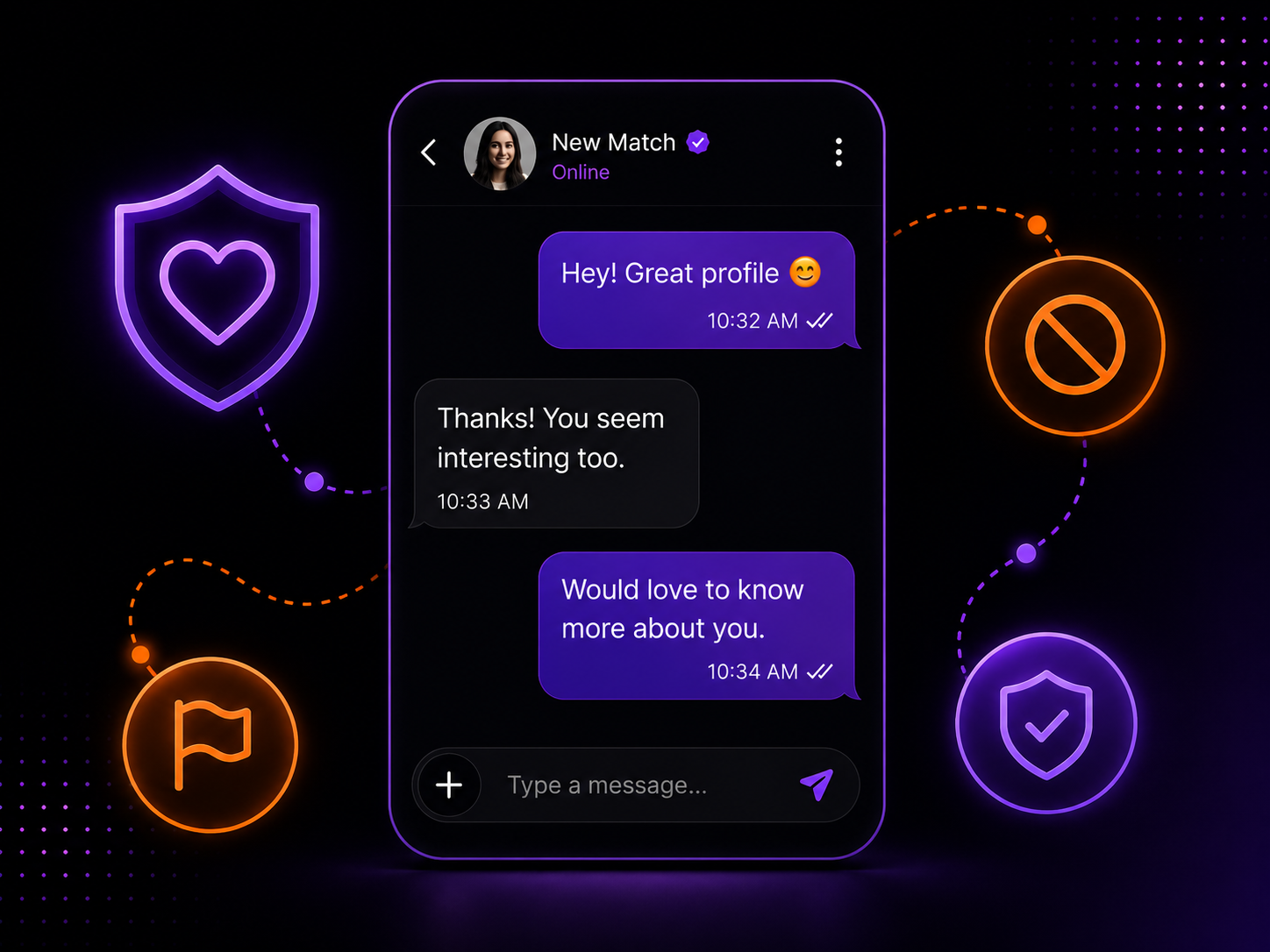
On most apps, blocking and reporting live three menus deep, styled like an afterthought. On a dating app they're core UX. A user in a bad conversation needs to end it in one tap, and they need to trust that reporting actually does something.
That means block and report belong in the message view, not buried in account settings. It means reports carry context - who, what, why - so your moderators can act instead of guess. And it means a reported user doesn't quietly resurface under a new match next week.
Match-expiry and messages that don't live forever
Plenty of dating products build urgency on purpose: matches that expire, conversations that vanish if no one speaks, messages that disappear after they're read. It's a design choice, and it's a good one - it nudges people to actually talk instead of collecting matches like trading cards.
The catch is that ‘make this message delete itself later’ is real infrastructure. You're scheduling deletions, handling the client that was offline when the timer fired, and keeping the timeline consistent for both people. Easy to hand-wave in a spec. Less easy at 2am when the timers drift.
Keeping the conversation on your platform
Here's the quiet one. A scammer's first goal is to move you to WhatsApp, Telegram, anywhere your safety tooling can't follow. The moment they succeed, you've lost your ability to protect that user and if the intent was fraud, you've lost your best evidence too.
Catching ‘hey what's your number’ is deceptively hard, because people phrase it a hundred ways and obfuscate the digits. But it's one of the highest-leverage things a dating platform can detect, and most in-house chat builds never get around to it.
Where CometChat fits into dating app safety
None of the above is exotic. It's just a lot to build well, on top of the messaging you also have to build well. That's the gap CometChat is built for.
The CometChat's moderation reads conversations in context, not one message at a time, and covers the dating-specific failure modes directly: explicit and non-consensual content, harassment and hate, impersonation and fraud, grooming and minor-safety signals, and platform-circumvention - the contact-swapping and off-app luring that leaks users away. Contact details and email addresses can be stripped before they land. Users can report content with a reason attached, and anything ambiguous routes to a human on a review dashboard instead of a coin flip. You can run moderation on CometChat's models, OpenAI's, or your own API.
Match-expiry and self-deleting messages aren't a workaround here - disappearing messages are a supported capability for both one-on-one and group chats, scheduled to delete at the time you set.
And the compliance groundwork - GDPR, SOC 2, ISO 27001, HIPAA, PIPEDA is already in place, which matters more in dating than most founders expect until legal asks.
Dating chat is a different sport. If you'd rather spend your time on matching than on rebuilding moderation from scratch, see how CometChat handles dating apps or start building free that's the part we've already played.

Shrinithi Vijayaraghavan
Creative Storytelling , CometChat