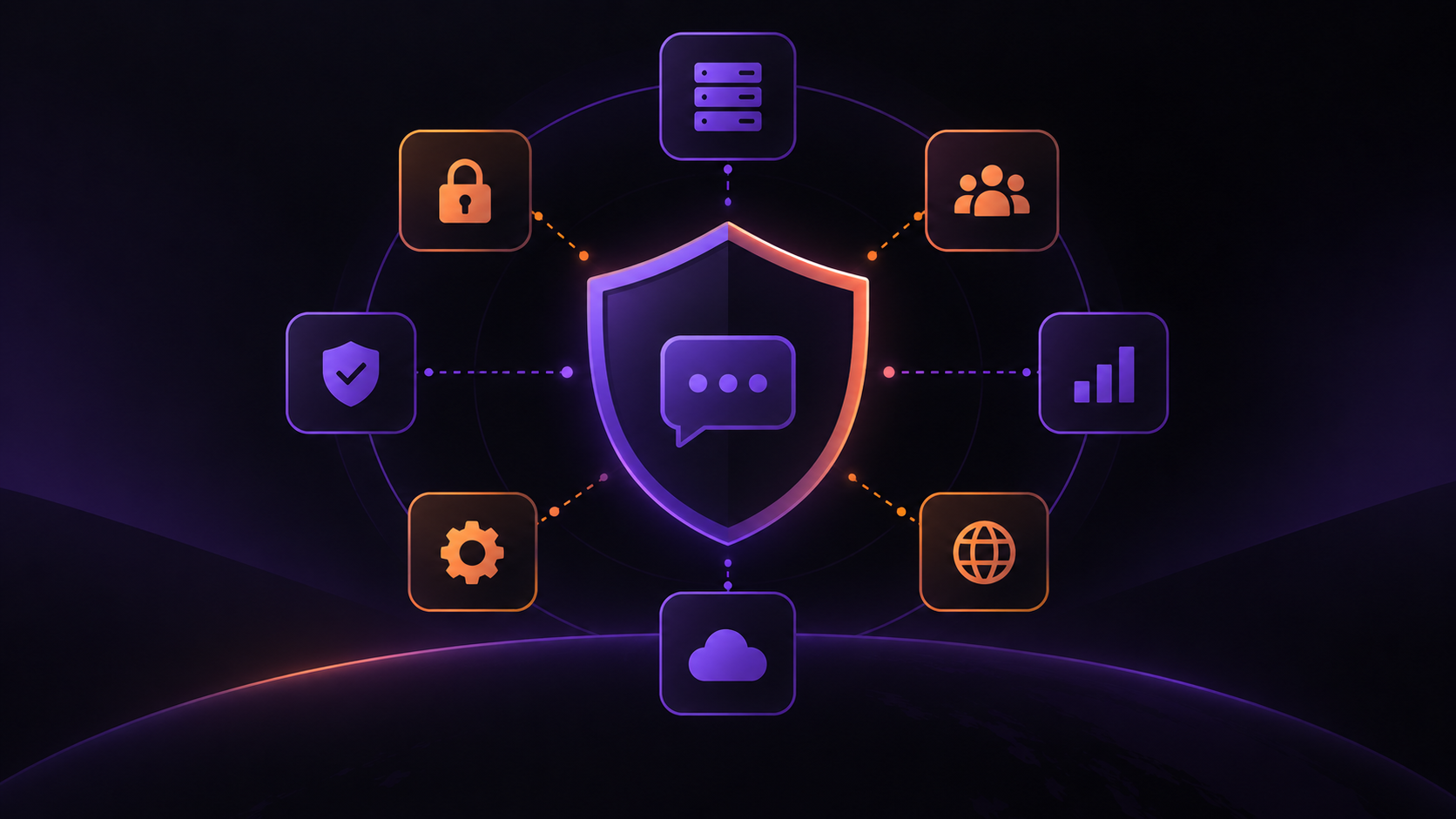
Enterprise chat needs eight things before it's safe to scale: encryption in transit and at rest, compliance certifications (SOC 2, HIPAA, GDPR), content moderation, audit logs, a real uptime SLA, granular access controls, data residency and retention control, and incident response you can actually verify. Miss any one of them and it stays invisible right up until it's a breach notice or an outage during your biggest launch. We know because we've spent over a decade on exactly this. CometChat builds chat, voice, and video SDKs and APIs that teams drop into their apps to ship messaging without standing up the whole real-time stack themselves and getting every one of the eight requirements below right took years of building. So treat this less as a pitch and more as the summary of what we’ve learnt: if you're buying enterprise chat, this is what you actually need
This is the list to forward to your CISO built for the people who sign off on procurement: security, compliance, and platform teams evaluating a chat vendor for production.
Why the boring requirements are the ones that bite
The features that sell chat like reactions, threads, typing indicators are not the features that get you fired. The ones that do are the requirements nobody demos: the audit log that wasn't there when legal asked for it, the moderation gap that let something illegal sit in a channel for a week, the ‘five nines’ SLA that turned out to be marketing copy with no credits attached.
Chat looks simple until it's carrying regulated data for a few hundred thousand users. Then every shortcut you took at the demo stage becomes a line item in a risk assessment. The checklist below is the set of shortcuts you don't get to take.
Ready to get real-time chat into your app? It is easier than you think.
The 8 requirements
1. Encryption in transit and at rest
Every message, file, and call should be encrypted both while moving across the network and while sitting in storage. In transit protects against interception; at rest protects against a stolen disk or a compromised database. You need both - one without the other is a half-answer.
The specific bar to ask about: TLS for data in transit, AES-256 for data at rest. CometChat encrypts data in transit and stores it with AES-256 in a private cloud with tightly restricted access. If a vendor can't tell you their cipher and where the keys live, that's the answer.
Where it gets harder: encryption is table stakes, but key management is where real programs separate from checkbox ones. Ask who holds the keys, how they rotate, and whether you can bring your own. The word ‘encrypted’ on a features page tells you almost nothing on its own.
What to verify:
TLS (or equivalent) for data in transit, AES-256 for data at rest
Where encryption keys are stored and who can access them
Key rotation policy, and whether bring-your-own-key is supported
That storage sits in an access-restricted environment, not a shared bucket
2. Compliance certifications: SOC 2, HIPAA, GDPR
The certifications that matter for enterprise chat are SOC 2 Type II, ISO 27001, HIPAA (with a signed BAA), and GDPR plus PIPEDA and CCPA depending on where your users are. These aren't interchangeable. SOC 2 attests to your vendor's security controls. HIPAA governs protected health information. GDPR governs the personal data of people in the EU and EEA. You need the ones that match your data and your users, and you need proof, not claims.
CometChat is SOC 2 Type II certified (its audit came back with zero exceptions), ISO 27001 certified, and compliant with HIPAA including signing a BAA - GDPR, PIPEDA, and CCPA. Reviews are run at least annually.
The distinction that trips people up: SOC 2 Type I says ‘the controls exist.’ SOC 2 Type II says ‘the controls actually worked over a period of months.’ Type II is the one that means something. Ask for the report, not the badge and check the date on it. A certification from three years ago is a story about a company that used to be compliant.
What to verify:
SOC 2 Type II (not just Type I), with a recent report date
ISO 27001 certification
HIPAA compliance and willingness to sign a BAA, if you handle health data
GDPR plus PIPEDA, CCPA, or others matching where your users live
That audits are run at least annually, with documents you can actually see
3. Content moderation
Moderation is the system that flags, reviews, and removes harmful content before it becomes your legal problem. At consumer scale, ‘we'll review reports manually’ is not a plan - it's a backlog. You need automated detection, a review workflow, and a record of what was actioned and by whom.
CometChat's moderation runs on an AI engine that reads conversation context, not just isolated keywords, which cuts false positives while catching the abuse that keyword filters miss. It covers text, images, and video, including mixed and multilingual content, with a rule engine you configure by user role, message type, channel, or confidence threshold and a flag-and-review flow where moderators approve or block from the dashboard or the API.
Where it bites in production: moderation that only works on single messages misses the abuse that lives across a conversation - grooming, coordinated harassment, slow-boil escalation. Context-aware matters, and so does the audit trail behind every decision. When a regulator asks what you removed and when, ‘we deleted it’ is not an acceptable answer. ‘Here's the timestamp, the rule, and the moderator’ is.
What to verify:
Automated detection, not manual-report-only review
Context-aware analysis, not just keyword matching
Coverage across text, images, and video, including multilingual content
Rules configurable by role, message type, channel, or confidence threshold
A flag-and-review workflow, with an audit trail behind every action
4. Audit logs
Audit logs are the tamper-resistant record of who did what, when every message action, moderation decision, admin change, and access event. When something goes wrong, the log is the difference between a two-hour investigation and a two-week one. When an auditor or regulator asks for proof, it's the only acceptable currency.
CometChat maintains audit trails across interactions, moderation decisions, and admin activity, with role-based access on the dashboard so the log itself is protected. The point of a log is that it can't be quietly edited by the person who needs to explain themselves.
The trap: plenty of platforms log some things. The question is coverage and immutability. Can an admin delete their own actions from the log? Can you export it? How long is it retained? A log you can tamper with is not an audit log - it's a suggestion.
What to verify:
Coverage of message actions, moderation decisions, admin changes, and access events
Whether an admin can edit or delete their own log entries
Export support, for your own retention and investigation needs
Retention period, and role-based access protecting the log itself
5. A real uptime SLA
An uptime SLA is a contractual commitment to availability, with financial credits when it's missed. ‘Highly available’ is not an SLA. ‘99.9%’ is and it means roughly 8.7 hours of downtime a year, which may or may not be fine for you. ‘99.999%’ means about five minutes a year. Know which number you're buying and read what happens when they miss it.
CometChat runs a 99.999% uptime SLA across 35+ edge locations, with dedicated infrastructure available on enterprise plans. Edge distribution matters here: uptime measured from one region is not the uptime your users in another region experience.
The part vendors hope you skip: the SLA is only as real as its remedy. An SLA with no credits, or credits capped at a token amount, is a number on a page. Ask what you actually get when they breach it, and whether planned maintenance counts against the number. It usually doesn't, for them.
What to verify:
The actual number (99.9% is ~8.7 hrs/year down; 99.999% is ~5 min)
That it's contractual, with financial credits when missed
What those credits are, and whether they're capped
Whether planned maintenance is excluded from the number
Geographic distribution, so uptime holds across your users' regions
6. Granular access controls
Access control means every person and system touches only the data their role requires - enforced by role-based access control (RBAC), not by trust. A support agent shouldn't see admin settings. A moderator shouldn't have billing access. And when someone leaves, their access should be gone the same day, not the same quarter.
CometChat supports role-based access across the dashboard, moderation, and admin functions, so permissions map to how your organization actually divides responsibility. SSO is table stakes on top of this - your users shouldn't need a separate credential just to open a chat window.
Where teams get this wrong: they buy SSO and call it access control. SSO is about who gets in. RBAC is about what they can do once they're in. You need both, and you need the second one to be granular enough to match your real org chart, not a generic admin/user split. The gap between those two is where most access incidents actually live.
What to verify:
Role-based access across dashboard, moderation, and admin functions
Granularity that matches your org, not just admin/user
SSO support, on top of RBAC - not as a substitute for it
How fast access is revoked when someone leaves
7. Data residency and retention control
Data residency is your control over where data physically lives; retention control is your control over how long it stays and how it's deleted. For regulated data and cross-border users, both are legal requirements, not preferences. GDPR's right to erasure and right to portability mean you need a real, programmatic way to export and delete a user's data on request.
CometChat offers shared storage in India, the United States, and Ireland, with dedicated-server and on-premise deployment for teams that need full control over where data sits. It provides a data deletion API for GDPR erasure requests, and standard retention keeps data available for at least six months, with longer periods by agreement and earlier deletion via the API.
The complication people discover late: ‘we're GDPR compliant’ and ‘we can delete a specific user's data across every backup and replica on request’ are different sentences. Ask about the second one. A deletion that leaves copies in a backup you can't reach is not a deletion - it's a liability with a delay on it.
What to verify:
Which regions data can be stored in, matching your residency requirements
Dedicated-server or on-premise options, if you need full control
A programmatic way to export and delete a specific user's data
Whether deletion reaches backups and replicas, not just the primary store
The default retention period, and whether it's adjustable
8. Verifiable incident response
Incident response is the vendor's documented, tested plan for detecting, containing, and reporting a breach including how fast they'll tell you. GDPR requires breach notification within 72 hours, so your vendor's response timeline is now part of your compliance posture. Their incident is your incident.
Ask for the plan, the notification SLA, and evidence it's been tested - penetration testing, tabletop exercises, third-party assessment. CometChat runs regular third-party penetration testing and maintains the security policies and incident procedures its SOC 2 and ISO 27001 audits verify.
The uncomfortable question worth asking: when was the last time they had an incident, and how did they handle it? A vendor who says ‘never’ is either very lucky, very new, or not looking hard enough. The useful signal isn't a perfect record - it's a clear, practiced answer to what happens when something goes wrong.
What to verify:
A documented incident response plan you can actually read
The breach notification timeline (GDPR requires 72 hours)
Evidence it's been tested - pen testing, tabletop exercises, third-party assessment
How they've handled a real past incident
The short version
Grade every chat vendor against the same eight: encryption at rest and in transit, the compliance certs that match your data, real moderation with a paper trail, tamper-proof audit logs, an SLA with teeth, RBAC that fits your org, residency and deletion you control, and an incident plan someone has actually tested. The ones that clear all eight are rare. The ones that quietly fail one are the expensive kind of surprise.
None of this is exciting. That's the point. These are the requirements that stay boring right up until the moment they're the only thing anyone's talking about.
Where CometChat lands on the checklist
CometChat clears all eight because it was built for teams shipping chat into regulated, high-traffic production, not for a demo. Encryption in transit and AES-256 at rest. SOC 2 Type II (zero exceptions), ISO 27001, HIPAA with a signed BAA, GDPR, PIPEDA, and CCPA. Context-aware AI moderation with a flag-and-review trail. Audit logs across interactions, moderation, and admin activity. A 99.999% uptime SLA across 35+ edge locations. Role-based access that maps to your org. Data residency in India, the US, or Ireland or on your own infrastructure plus a deletion API for GDPR requests. Third-party penetration testing behind the incident procedures the audits verify.
The honest version: no vendor removes your obligations. You still own your data policy, your access hygiene, and your response plan. What CometChat does is give you a foundation that already passes the review, so the eight requirements above stop being eight projects and start being eight boxes you can actually check. If that's the review you're staring down, talk to our team bring the CISO's list.
FAQ
What are the minimum security requirements for enterprise chat? At minimum: encryption in transit and at rest, SOC 2 Type II certification, role-based access control, audit logging, and a documented incident response plan. Add HIPAA (with a BAA) if you handle health data and GDPR compliance if you have EU users. Anything less isn't enterprise-grade, regardless of the label on the pricing page.
Is SOC 2 enough for enterprise chat compliance? No - SOC 2 covers your vendor's security controls, but it doesn't cover regulation-specific obligations. If you handle protected health information you also need HIPAA and a signed BAA; if you have EU users you need GDPR. SOC 2 is necessary for most enterprise deals but rarely sufficient on its own.
What's the difference between SOC 2 Type I and Type II? Type I confirms security controls exist at a point in time. Type II confirms those controls operated effectively over a period, usually 3–12 months. Type II is the stronger attestation, and it's the one most enterprise buyers require. Ask for the report and check its date.
Does CometChat support HIPAA compliance? Yes. CometChat is HIPAA compliant and will sign a Business Associate Agreement (BAA), which is required before you route protected health information through any vendor. It's also SOC 2 Type II certified, ISO 27001 certified, and GDPR, PIPEDA, and CCPA compliant.
What uptime SLA should enterprise chat have? For production chat carrying real user traffic, look for 99.99% or higher, backed by financial credits when it's missed. 99.999% (roughly five minutes of downtime a year) is the top tier. CometChat offers a 99.999% uptime SLA across 35+ edge locations. Always confirm what the credits are and whether planned maintenance is excluded.
How do I verify a chat vendor's compliance claims? Ask for the actual documents, not badges: the SOC 2 Type II report, ISO certificate, and a sample BAA. Check the dates. Confirm annual reviews, request their penetration testing summary, and ask how they handle a user data deletion request end to end, including backups. A vendor comfortable with those questions is usually one worth trusting.

Shrinithi Vijayaraghavan
Creative Storytelling , CometChat