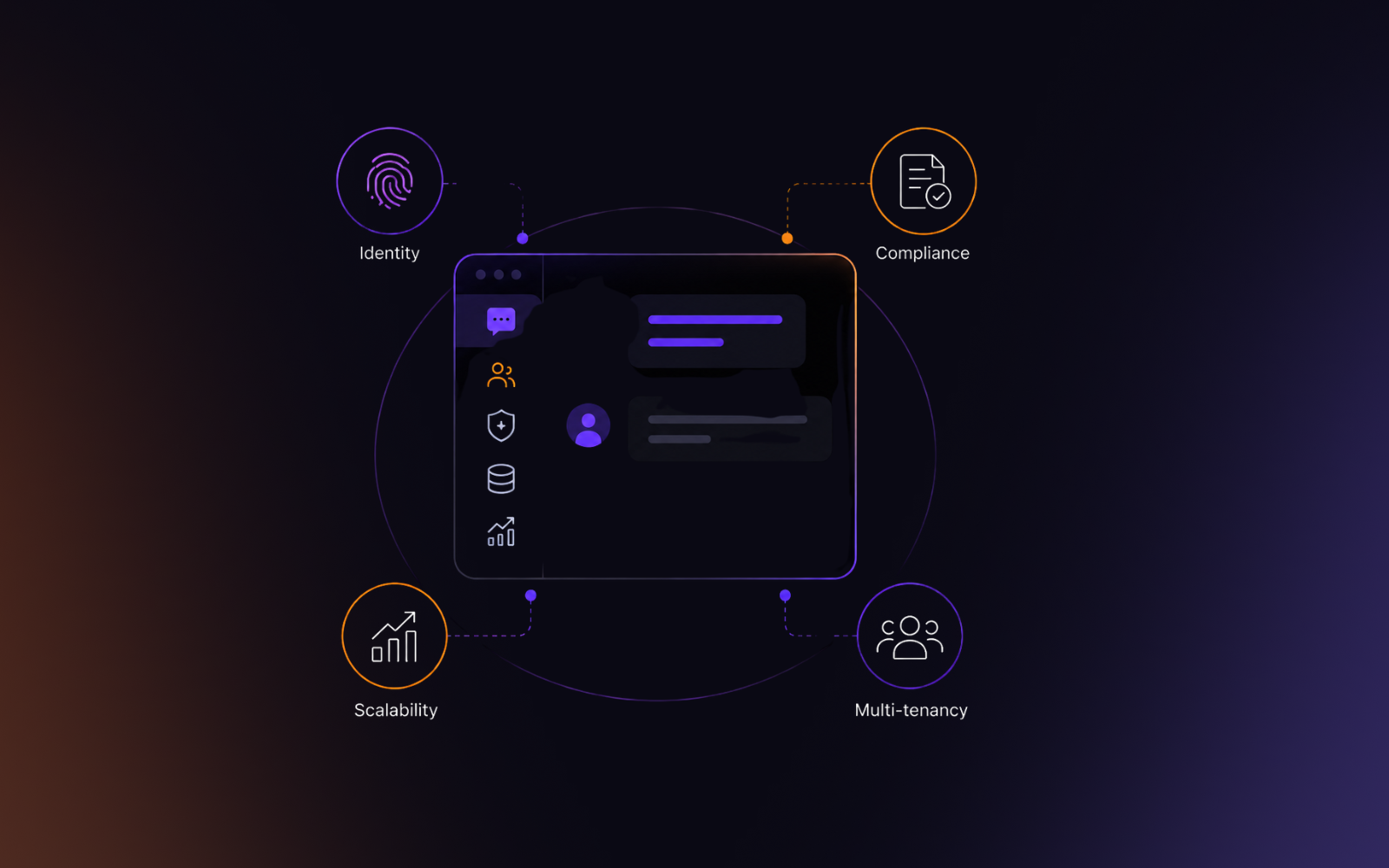
Most feature lists for enterprise chat read like a procurement checklist - SSO, encryption, audit logs, check, check, check. That's fine for comparing vendor PDFs, but it doesn't tell you why any of it matters in practice, or which features separate a system that works from one that quietly causes problems at scale.
This post goes through the features that genuinely define enterprise chat, with some honest commentary on what each one involves and where things get complicated. It also covers where CometChat fits for organizations building custom chat infrastructure.
1. Identity and Access Management
Getting identity right is where enterprise chat either earns trust or loses it early. SSO integration is table stakes - your users shouldn't need separate credentials just to open a chat window. But the more important piece is role-based access control that maps to how your organization actually works.
Permissions in large organizations are rarely flat:
A compliance officer needs different visibility than a sales rep
A contractor working with one team shouldn't have access to channels across the org
RBAC that's too coarse forces admins into workarounds; too granular, and it becomes unmanageable after the first reorg
The part most teams overlook: automated de-provisioning. The access gap between an employee's last day and when their account is actually removed is a real risk and a common one.
2. Data Sovereignty and Deployment Flexibility
This is the feature most organizations underestimate until it becomes a blocker.
Consumer chat platforms store your data on shared infrastructure, in regions and configurations you don't control. For most companies, that's fine. For others, it isn't.
| Who it affects | Why it matters |
|---|---|
Healthcare (HIPAA)
| Patient data cannot live on shared vendor infrastructure
|
Financial services
| Data residency requirements dictate where messages are stored
|
Defense / government
| Air-gapped environments; no external network access
|
Legal
| Attorney-client privilege requires complete data control
|
Enterprise chat that takes this seriously gives you on-premises deployment, private cloud hosting in specific regions, and complete message ownership. That last part is easy to gloss over when everything is working, and very hard to undo when it isn't.
3. Compliance and Governance
The specifics vary by industry, but the underlying need is the same: when something goes wrong, you need to be able to prove what happened, when, and who was involved.
What this actually requires in practice:
Comprehensive audit logs: not optional in regulated environments
eDiscovery support: search, export, and preserve specific conversations under legal hold
Configurable retention policies: ‘keep everything forever’ and ‘delete after 30 days’ are both wrong depending on context; you need the middle ground
Industry certifications: SOC 2 Type II, ISO 27001, HIPAA. Worth examining, not just collecting
One thing on certifications: a SOC 2 report describes controls in place at audit time. What matters operationally is whether those controls hold under your specific deployment configuration.
4. Integration With Existing Systems
Chat that lives in isolation isn't worth much to an enterprise. The value compounds when it connects to the systems your teams already use.
REST APIs and webhooks are the foundation, but the interesting work is in bi-directional integration:
Approval requests that route to Slack are nice. Approval requests that route through chat and actually update the underlying record in your ERP with a full audit trail are useful.
The integration layer also needs to handle custom authentication. If your internal identity management runs on a proprietary stack, your chat system integrates with that — not the other way around.
5. Multi-Tenant Architecture
Organizations aren't monolithic. A single enterprise deployment might need to serve:
Internal teams with strict data separation between departments
External partners with access to specific project channels only
Customers in a support or community context
Multi-tenant architecture handles this at the infrastructure level in isolated environments per tenant, with their own security policies, branding, and permission models, and controlled cross-tenant communication when it's appropriate.
The distinction worth understanding: logical separation that lives only in application code is not the same as true tenant isolation. That difference becomes very relevant if you're ever audited or breached.
6. Communication Formats Beyond Text
One-to-one messaging and group chats are the baseline. Enterprise chat needs to handle the full range:
| Format | What to watch for |
|---|---|
Voice and video calling
| Reliability under network variance, quality at scale
|
Screen sharing
| Latency, access controls during session
|
Broadcast channels
| Moderation controls, delivery confirmation
|
Threaded conversations
| Search and archival behaviour
|
None of these are hard to build a demo of. All of them take real work to operate reliably at scale.
7. Scalability and Reliability
This is where chat stops feeling like a product and starts feeling like infrastructure and where getting it wrong becomes very visible. Chat has a way of breaking at the exact moment you demo it.
The numbers that actually matter:
Concurrent users, not registered users - a system might handle 10,000 registered users fine with 500 concurrent; the behavior at peak is what matters
Message throughput at peak load, not average
Failover behavior - what happens when a node goes down mid-conversation
Geographic distribution - for latency, compliance, and redundancy
Low-latency delivery, automatic failover, and regional distribution aren't features you notice when they're working. You notice them when they aren't.
8. Administration and Moderation
Centralized dashboards, usage analytics, and moderation tools sound like back-office concerns and they are but they're what keeps a large deployment manageable. Specifically:
User provisioning at scale - adding and removing users in bulk, synced with HR systems
Policy enforcement - consistent application of channel rules, data handling, and access controls
Custom moderation rules - automated flagging based on content patterns, human review queues, escalation paths
The moderation stack matters both in consumer-facing deployments and in regulated internal environments. The goal is a system where the operational burden doesn't scale linearly with user growth.
9. Programmability and Automation
This is where enterprise chat stops being a communication layer and starts being an operational one.
What programmable chat infrastructure makes possible:
Sending messages from automated systems (alerts, status updates, approvals)
Chatbots and AI agents that participate in workflows, not just answer FAQs
Business processes triggered by chat events
Real-time data surfaces within chat context - dashboards, records, transaction data
Agent-to-agent communication for fully automated processes
If your chat infrastructure isn't built to support programmatic participation, you'll hit that ceiling sooner than expected especially as more workflow automation starts routing through conversational interfaces.
How These Features Fit Together
It's tempting to read this list and evaluate each feature in isolation. But they're interconnected in ways that matter at the architectural level.
Data sovereignty shapes which deployment model is viable → which affects compliance posture → which affects what integrations are possible. Identity management intersects with multi-tenant architecture. Scalability requirements shape infrastructure decisions underneath everything else.
Enterprise chat done well is a coherent system. That's why ready-made solutions work until they don't - they're built for breadth, not for the specific ways complex organizations operate.
If you're evaluating whether to build or buy, the question isn't ‘does this platform have these features?’ It's ‘can I configure and control these features in a way that actually fits how we work?’
Where CometChat Fits In
Everything above - identity, compliance, multi-tenancy, integrations, scalability - is what CometChat is built to handle. For organizations on self-hosted or private cloud deployments, it gives you the infrastructure, SDKs, and APIs to build enterprise chat where the deployment, the data, and the security model are entirely under your control, not the vendor's. You build on proven infrastructure and own what you ship.

Shrinithi Vijayaraghavan
Creative Storytelling , CometChat